If someone may be overdosing right now, call 911 immediately. Signs can include slow or stopped breathing, blue or gray lips or fingertips, being unable to wake up, or having a seizure. Don’t wait to read the rest of this page before getting emergency help. See “What to do if you think someone is overdosing” for additional information once help is on the way.
What you’ll learn
If you’re worried about your own kratom or 7-OH use, or you know someone else taking either, this guide is for you. We cover what an overdose looks like, why concentrated 7-OH raises the risk, and exactly what to do, including when to call 911 and how naloxone fits in.
If you’re asking about the possibility of a kratom overdose, you’re already taking it seriously, and that matters. Kratom is often sold and talked about as a natural supplement, so it’s easy to assume it can’t cause a real medical emergency. That assumption isn’t safe, especially with how much stronger some 7-OH products on the market have become.
Can you overdose on kratom?
Yes. Kratom and 7-OH can both cause an overdose, especially at high doses, with concentrated 7-OH products, or when either is combined with other substances. It doesn’t always look like what most people picture when they think of an overdose, but it can be just as dangerous.
Warning signs of a kratom or 7-OH overdose
Symptoms show up differently depending on which system they disturb. Here’s what to watch for, grouped by what’s affected:
- Stomach: nausea, vomiting
- Heart: a fast or irregular heartbeat, high blood pressure
- Brain and behavior: drowsiness, confusion, agitation, seizures, and what some people call “the wobbles”: a wave of dizziness and involuntary eye movement
- Breathing (the most dangerous): slow or shallow breathing, trouble staying awake, unresponsiveness
Rare but severe cases have also involved muscle breakdown, temporary hearing loss, and heart failure after heavy use.
Call 911 immediately if you see any of these:
- Slow or stopped breathing
- Blue or gray lips or fingertips
- They can’t be woken up
- They’re having a seizure
Why concentrated 7-OH products are more dangerous than leaf kratom
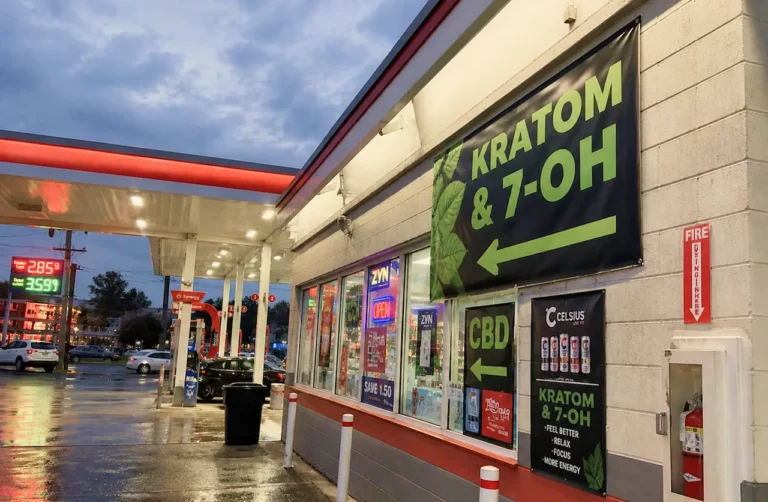
Natural leaf kratom contains only trace amounts of 7-OH. But some commercial products (gummies, shots, tablets) have been tested at concentrations up to around 40%.
At that level, 7-OH acts much more like a potent opioid and raises the risk of dangerous breathing suppression. You can read more about what that does to the brain and body in our article discussing 7-OH effects.
We want to be upfront that much of this evidence comes from several published case reports, not from large studies. We’re still learning exactly how much more dangerous concentrated 7-OH is compared with leaf kratom.
What we’ve heard from our own patients
This research lines up with what we see in our own patients. People coming off 7-OH regularly describe a withdrawal that feels as bad as, or worse than, withdrawal from stronger prescription opioids.
The symptoms that come up most often are severe trouble sleeping, restlessness, heavy sweating, nausea, diarrhea, body aches, intense cravings, and anxiety. Many tell us they tried to stop cold turkey and couldn’t get through it on their own, which is what finally brought them in for care.
Here’s another pattern we see: someone starts on a prescription opioid, turns to 7-OH hoping it will ease the withdrawal from that opioid, and ends up dependent on 7-OH instead.
To be direct: kratom and 7-OH don’t safely treat opioid withdrawal. Using one to get off the other usually just trades one dependence for another.
And with several states now banning concentrated 7-OH outright and a federal scheduling action expected soon, people who relied on it are starting to lose access. If you’re unsure about the legality where you live, check out our article on current kratom and 7-OH laws.
What to do if you think someone is overdosing
This is the most important part of this article. If you see any of the warning signs, work through these four steps.
Step 1: Call 911 right away.
Do this first for any red-line symptom: slow or stopped breathing, unresponsiveness, blue or gray lips, or a seizure. Most states have Good Samaritan laws that protect the person who calls for help, even if drugs were involved.
Step 2: Give naloxone (Narcan) if you have it.
Kratom and 7-OH affect the body the same way opioids do, so naloxone can reverse an overdose from either one just as effectively. Give one dose, wait 2 to 3 minutes, and give a second dose if breathing hasn’t improved. Naloxone is available at most pharmacies, often without a prescription.
Step 3: Keep them breathing and on their side.
If they’re breathing but not fully awake, roll them onto their side (the recovery position) so they don’t choke if they vomit. Try to keep them awake and breathing until help arrives.
Step 4: Stay with them and tell responders what was taken.
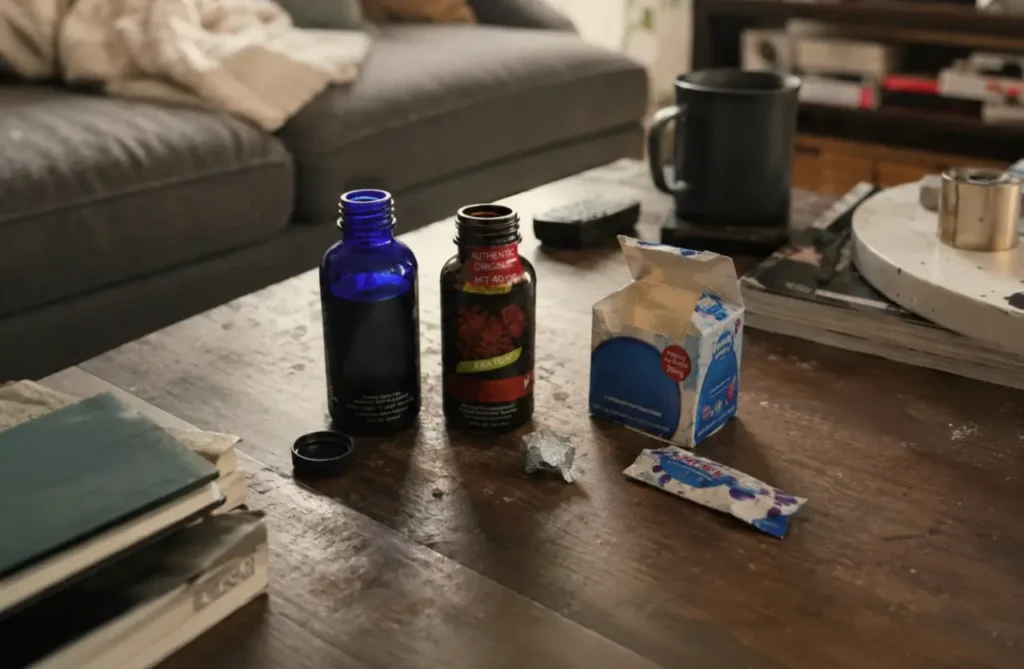
Don’t leave until help arrives. Tell paramedics exactly what was taken if you know, including the product name and any other items involved, and keep the packaging so they can see it.
A word on “rebound”: Naloxone only works for about 30 to 90 minutes, and kratom or 7-OH can stay active in the body longer than that. That means someone can seem okay, then stop breathing again once the naloxone wears off. This is called rebound. This is why calling 911 still matters even after someone wakes up, and why they need to be watched closely and may need another dose.
When kratom overdose is more likely: dangerous drug combinations
Most kratom-related deaths involve more than one substance. In a CDC review of kratom-positive overdose deaths, fentanyl or similar drugs were present in about 65% of cases, benzodiazepines in about 22%, and alcohol in about 13%.
Combining kratom or 7-OH with opioids, benzodiazepines, or alcohol sharply raises the risk of dangerous breathing suppression. Each of these slows breathing in similar ways, and the effects compound.
Who is at the highest risk for a kratom overdose?
Anyone can have a bad reaction, but the risk is higher for people who are:
- Using concentrated 7-OH products instead of plain leaf kratom
- Combining kratom or 7-OH with opioids, benzodiazepines, or alcohol
- New to opioids, with little or no tolerance built up
- Trying to manage opioid withdrawal with kratom or 7-OH on their own (as noted above, this tends to create a new dependence rather than solve the original one)
Is a kratom overdose fatal?
It can be, though deaths from kratom alone are less common than deaths involving stronger opioids like fentanyl or heroin. One CDC report identified 91 kratom-involved overdose deaths over an 18-month period, with kratom as the only substance detected in seven of them. Poison control centers have also logged a rising number of kratom-related calls over the past decade.
In one recent case, a person went into cardiac arrest after using 7-OH and was revived with naloxone. It’s a real example, and a reminder that these overdoses, while serious, can be survivable with fast action.
Getting help after a kratom or 7-OH overdose
An overdose usually means kratom or 7-OH use has gone further than someone can manage alone. That’s a sign of kratom use disorder (KUD), not a personal failure in any way. This is far more common than it might feel in the moment.
Suboxone® (buprenorphine-naloxone), the same medication used to treat opioid use disorder, is also used to treat kratom and 7-OH dependence. QuickMD’s licensed doctors can help you start treatment or get a Suboxone prescription online in 40+ states, often the same day.
Frequently asked questions about kratom overdose
How much kratom is too much?
There’s no single amount that’s safe for everyone. It depends on the product, how concentrated it is, and a person’s own tolerance. Products marketed as “extra strength” or “enhanced” and anything containing concentrated 7-OH carry a much higher overdose risk than plain leaf kratom, even at what seems like a normal dose.
Can giving naloxone cause withdrawal symptoms?
It can, if the person is physically dependent on kratom, 7-OH, or another opioid. Naloxone can bring on sudden, uncomfortable withdrawal symptoms like nausea, sweating, and agitation, but this isn’t dangerous the way an overdose is. Don’t let the possibility of withdrawal stop you from giving it. Reversing the overdose comes first.
What happens at the hospital after a kratom overdose?
Hospital staff will monitor breathing and heart rate, administer additional naloxone if needed, and provide supportive care such as IV fluids or oxygen. They may also run tests to check for other substances involved, since combinations are common. Most people are monitored for a few hours before being released or admitted, depending on how serious the overdose was.
What should I do after surviving an overdose?
Talk to a doctor as soon as you can. An overdose is a sign that kratom or 7-OH use has become more than you can safely manage on your own, and a licensed doctor can help you find a safer way forward, including medication if it’s a good fit, without judgment.
Disclaimer
Articles on this website are meant for educational purposes only and are not intended to replace professional medical advice, diagnosis or treatment. Do not delay care because of the content on this site. If you think you are experiencing a medical emergency, please call your doctor immediately or call 911 (if within the United States). This blog and its content are the intellectual property of QuickMD LLC and may not be copied or used without permission.
References
Olsen, E. O., et al. (2019). Unintentional drug overdose deaths with kratom detected: 27 states, July 2016–December 2017. CDC MMWR, 68(14), 326–327. https://www.cdc.gov/mmwr/volumes/68/wr/mm6814a2.htm
Post, S., et al. (2019). Kratom exposures reported to United States poison control centers: 2011 to 2017. Clinical Toxicology, 57(10), 847–854. https://doi.org/10.1080/15563650.2019.1569236
Sangani, V., et al. (2021). Unusual presentation of kratom overdose with rhabdomyolysis, transient hearing loss, and heart failure. Journal of Investigative Medicine High Impact Case Reports. https://pmc.ncbi.nlm.nih.gov/articles/PMC8767650/
Pullman, S., et al. (2025/2026). Cardiac arrest revived with naloxone following reported 7-OH use. Clinical Toxicology. https://doi.org/10.1080/15563650.2025.2565428
Kruegel, A. C., et al. (2019). 7-Hydroxymitragynine is an active metabolite of mitragynine and a key mediator of its analgesic effects. ACS Central Science, 5(6), 992–1001. https://doi.org/10.1021/acscentsci.9b00141
Texas Department of State Health Services. (2025). Serious illnesses associated with 7-OH use. https://www.dshs.texas.gov/news-alerts/serious-illnesses-associated-7-oh-use
Smith, K. E., et al. (2022). Assessment of kratom use disorder and withdrawal. Journal of Addiction Medicine. https://pubmed.ncbi.nlm.nih.gov/35220331/
National Institute on Drug Abuse. Naloxone DrugFacts. https://nida.nih.gov/publications/drugfacts/naloxone
Centers for Disease Control and Prevention. 5 things to know about naloxone. https://www.cdc.gov/overdose-prevention/reversing-overdose/about-naloxone.html
QuickMD has strict referencing policies and relies on reputable sources, including peer-reviewed research, clinical guidelines, medical organizations, and government and public health agencies, among others. Learn more about how we ensure accuracy in our content by reading our editorial guidelines.