What you’ll learn
We’ll cover which clinicians can prescribe Suboxone®, what to do if yours can’t, and why medical supervision matters throughout your recovery journey.
If you’ve been dealing with opioid use disorder (OUD) and are taking your first steps on your recovery journey, Suboxone® is a life-changing medication that’s the cornerstone of a Medication-Assisted Treatment (MAT) program. However, not every doctor can prescribe Suboxone. Thankfully, federal rules changed for the better in 2023. Today, more clinicians than ever can prescribe medications for OUD. That includes primary care doctors, nurse practitioners, physician assistants, and more. In fact, any doctor with a valid medical license and DEA registration is allowed to prescribe it in the state they’re licensed in.
If you’ve been putting off treatment because finding a doctor seemed complicated, it might be easier than you think. Those same 2023 regulation changes opened the door to more licensed clinicians prescribing Suboxone through telemedicine platforms. This is a big deal if finding a doctor or getting to an office or clinic isn’t realistic for you.
If you’re interested in learning more, our doctors here at QuickMD can prescribe Suboxone and help you get started on your path to recovery.
What is Suboxone and how does it work?
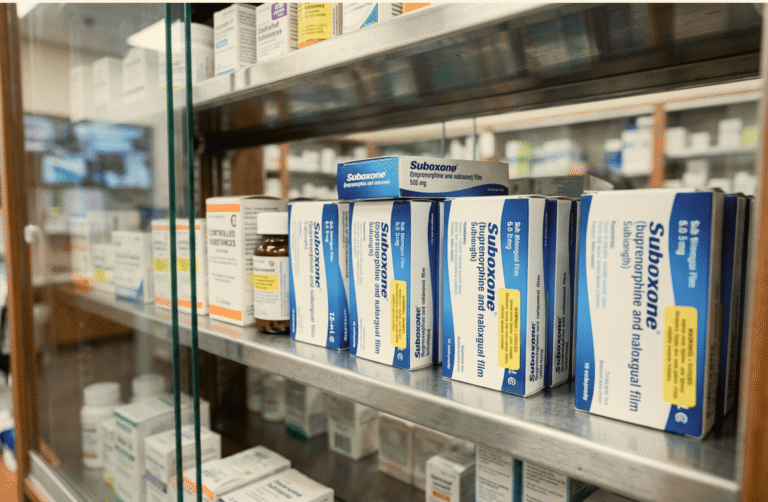
Suboxone is a prescription medication that treats OUD. It combines two active ingredients:
- Buprenorphine is a partial opioid agonist, meaning it activates the same receptors in your brain that opioids do, but at a much lower level. It eases withdrawal symptoms and calms cravings without producing euphoric highs.
- Naloxone is an opioid antagonist that blocks opioid receptors. It’s added to act as a safety net that prevents misuse. The naloxone stays inactive when you take Suboxone as directed, and it dissolves under your tongue. But if the medication is injected, naloxone activates and blocks any opioid effects or highs.
Who can prescribe Suboxone?
A 2023 study showed that 61% of Americans didn’t know that primary care providers could prescribe medication to treat OUD. So, while not every clinician can prescribe Suboxone, more can than most people realize. Any clinician can prescribe it as long as they have a current DEA registration and have completed the required 8 hours of training on substance use disorders.
Authorized clinicians are typically doctors, nurse practitioners, physician assistants, addiction specialists, and psychiatrists. You may be able to get prescribed Suboxone through:
- Primary care offices
- Addiction treatment clinics
- Telemedicine providers
- Opioid treatment programs
- Some emergency departments or hospitals
If you’d rather skip the waiting room, we prescribe Suboxone through telemedicine visits as part of our MAT program here at QuickMD. One of our doctors will evaluate your health and medical history to make sure Suboxone is safe and appropriate for you. If it is, your doctor can get you started with Suboxone, whether you’re dealing with opioid or kratom/7-OH use.
Why is there confusion around who can prescribe Suboxone?
Before 2023, clinicians needed a special federal waiver to prescribe Suboxone for OUD, and those waivers weren’t open to every licensed prescriber. There were also caps on how many patients a single clinician could treat and restrictions on prescribing through telemedicine.
All of that made it harder to find treatment, especially in rural areas and for patients who had to seek out separate, chemical dependency-focused clinics instead of being able to get help from their primary care provider. Those rules changed in 2023, opening up prescribing to far more clinicians across primary care, telemedicine, and other settings.
So, if you’re seeing conflicting answers about who can prescribe Suboxone, that’s why. The laws and rules have changed, but a lot of outdated information is still floating around online.
Why you need a doctor for a Suboxone prescription
Suboxone is a controlled medication that works directly on the opioid receptors in your brain. Your doctor will make sure you get the right dose and help you safely manage any potential side effects.
Tailored treatment plans
The right Suboxone dose depends on factors like how long you’ve been using opioids, how much you’ve been taking, and what else is going on with your health. Starting too low can leave you dealing with withdrawal symptoms, and too high can increase the risk of side effects.
Monitoring for safety
Side effects like nausea, headaches, and drowsiness are common when you first start Suboxone. Your doctor can tell what’s normal because you’re adjusting, and what could indicate the dosage needs to change. If you have conditions like liver disease or are taking other medications, your doctor will factor these into your treatment plan to avoid harmful interactions.
Can some doctors refuse to prescribe Suboxone?
Even though prescribing rules have expanded, not every clinician who can prescribe Suboxone actually does. Some doctors don’t treat substance use disorders or don’t have experience in addiction medicine. Others may not be comfortable managing Suboxone or may have concerns about regulatory requirements.
You’re not out of options if a doctor turns you down. If you need help finding a doctor who specializes in opioid use disorder treatment, SAMHSA has a searchable directory of programs from every U.S. state.
What about pharmacies?
Some pharmacies may refuse to fill a Suboxone prescription even after your doctor calls it in. The reasons are complex and vary widely, ranging from stigma and misconceptions to fears of DEA regulatory enforcement and litigation.
Here are a few things that can help:
- Use the same pharmacy consistently so staff are familiar with your prescription.
- Call ahead to confirm they carry your medication before you show up.
- Bring your ID and insurance information if you’re not paying out of pocket.
- Make sure your doctor sends the prescription exactly as required.
- Let your doctor know right away if you’re having any problems so they can send it to another pharmacy.
If you’d rather avoid the pharmacy altogether, QuickMD offers home delivery so your medication comes directly to you. Our convenient cash pay model also aims to keep costs low and does not require insurance to get access to the safe, discreet care you deserve.
The risks of self-medicating with Suboxone
There are a lot of reasons why people consider taking Suboxone without a prescription. And many of those reasons come from feeling like their options are limited. For instance, someone may live in a small town and can’t find a doctor, or they may be in withdrawal right now, and someone they know has some. That’s all understandable, but self-medicating carries risks that can make things worse.
Self-medicating with Suboxone comes with several major risks.
- Sudden withdrawal: If you take Suboxone while other opioids are still active in your system, the buprenorphine stops them cold all at once, triggering a severe withdrawal. The timing window is difficult to gauge without medical training, and this is the kind of reaction that sends people to the ER.
- Improper dosing: Suboxone doses vary based on what you’ve been using, how much, and for how long. Too little can mean withdrawal symptoms, and too much runs the risk of heavy sedation or slowed breathing. Suboxone can also interact dangerously with benzodiazepines or alcohol.
- No safety net: Without a doctor coordinating your care, there’s no one adjusting your dose, catching side effects early, or connecting you with the counseling and support that help people stay in treatment long-term.
- Legal risk: Obtaining Suboxone without a prescription is illegal and could lead to arrest or criminal charges.
Find a doctor today and start your recovery journey with Quick MD
If you’re starting your recovery journey, you don’t have to figure out your options alone. At QuickMD, our licensed doctors can evaluate whether Suboxone is right for you and help you get started with a convenient telemedicine visit from the comfort and privacy of home.
Disclaimer
Articles on this website are meant for educational purposes only and are not intended to replace professional medical advice, diagnosis or treatment. Do not delay care because of the content on this site. If you think you are experiencing a medical emergency, please call your doctor immediately or call 911 (if within the United States). This blog and its content are the intellectual property of QuickMD LLC and may not be copied or used without permission.
References
Diversion Control Division: Opioid Use Disorder – MATE Act Q&A. (2023). U.S. Department of Justice. https://www.deadiversion.usdoj.gov/faq/MATE_Act_faq.html
National Institutes of Health. (2024). Most Americans don’t know that primary care physicians can prescribe addiction treatment. https://www.nih.gov/news-events/news-releases/most-americans-don-t-know-primary-care-physicians-can-prescribe-addiction-treatment
Sokol, R. (2024). After the MATE act: integrating buprenorphine prescribing into mainstream family medicine education and practice. Family Medicine. 2024;56(2):74-75. https://pmc.ncbi.nlm.nih.gov/articles/PMC10932557/
Sivils, A., Lyell, P., Wang, J.Q., Chu, X.P. (2022). Suboxone: history, controversy, and open questions. Frontiers in Psychiatry. 2022;13. https://pmc.ncbi.nlm.nih.gov/articles/PMC9664560/
SAMHSA. (2026). Opioid Treatment Program Directory. https://www.samhsa.gov/find-help/locators/opioid-treatment-program-directory
SAMHSA. (2023). Policy Priority Roundtable Summary Report Improving Buprenorphine Access in Pharmacy Settings. https://www.samhsa.gov/sites/default/files/policy-priority-roundtable-buprenorphine-access-pharmacies.pdf
Zhu, T., Noor-E-Alam Md, Hasan, M., Young, L., Young, G. (2025). Counseling as a complement to buprenorphine treatment for opioid use disorder: A retrospective observational study of patient outcomes. Journal of Substance Use and Addiction Treatment. 2025:209719. https://www.sciencedirect.com/science/article/pii/S2949875925000980
QuickMD has strict referencing policies and relies on reputable sources, including peer-reviewed research, clinical guidelines, medical organizations, and government and public health agencies, among others. Learn more about how we ensure accuracy in our content by reading our editorial guidelines.