If thoughts of self-harm show up at any point, call or text the 988 Suicide and Crisis Lifeline or chat at 988lifeline.org. Call 911 in an emergency. Don’t wait for your next visit.
What you’ll learn
We’ll walk you through what escitalopram (Lexapro®) is, what it treats, what it acts on, how long it takes to help, what the first few weeks tend to feel like, how dosing works, what side effects to expect, and how it differs from citalopram (Celexa®).
If you’re starting escitalopram (Lexapro®) for depression or anxiety, you probably have questions about what to expect. Understanding how the medication works, when you might notice changes, and what side effects to watch for can help you feel more informed and prepared before taking your first dose.
What is escitalopram (Lexapro®)?
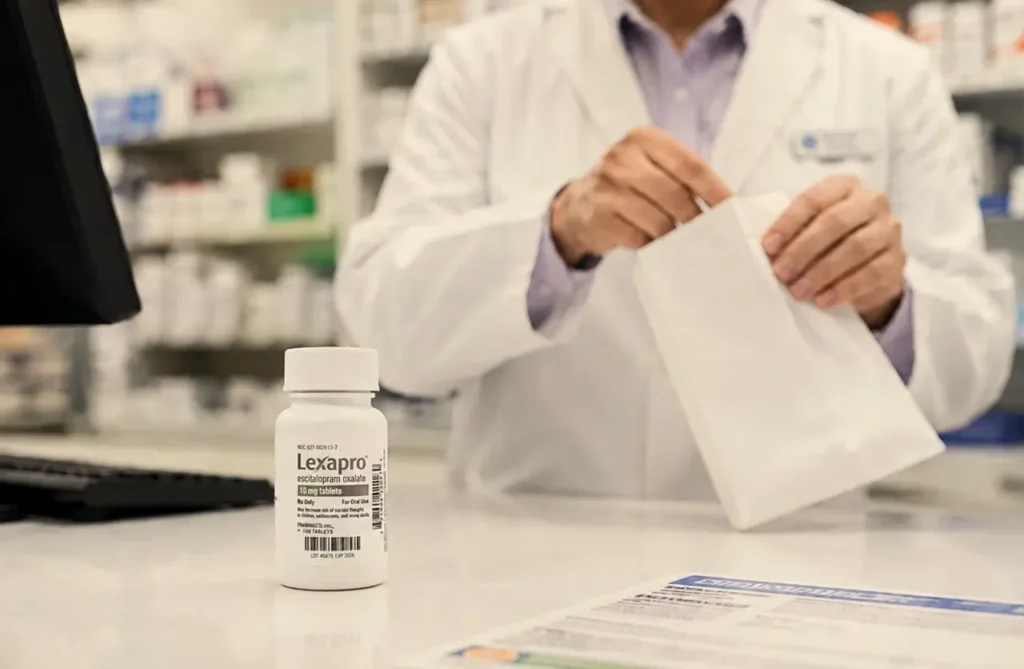
Escitalopram is a prescription antidepressant in a class of medications called selective serotonin reuptake inhibitors, or SSRIs. Lexapro is the brand name, and escitalopram is the generic form of the same medication. Doctors prescribe it as a tablet you take once a day.
If you’re dealing with depression or anxiety, escitalopram (Lexapro) is one of the medications our doctors consider early. It’s well established, most people tolerate it well, and it comes up often in online mental health care visits. Sertraline (Zoloft®) usually comes up around the same time, and doctors often weigh the two together before deciding which one fits your symptoms and history.
The main thing your doctor will want to know about is your heart. Escitalopram can affect heart rhythm, so if you have a heart condition or other heart risk factors, your doctor will be careful with your dose or may decide a different medication is the better option. We go into more detail on that in the side effects section below.
The FDA approves escitalopram (Lexapro) to treat:
- Major depressive disorder (MDD)
- Generalized anxiety disorder (GAD), ongoing, excessive worry that shows up most days for six months or more, often alongside restlessness or trouble sleeping
The FDA label extends these approvals to some patients younger than 18. QuickMD treats adults 18 and older only, so if you’re reading this for yourself, the label’s adult indication applies to you.
A comparison of 21 antidepressants placed escitalopram (Lexapro) among the more effective and better-tolerated options studied.
What escitalopram does, and why it may take time to feel it
Your brain uses a chemical called serotonin to pass messages between nerve cells. After a message goes through, the cell that sent it pulls some of that serotonin back in. Escitalopram (Lexapro) slows that pullback, so more serotonin stays where it can keep working.
That part starts with your first dose. The part you actually notice takes longer. Changes in your mood, your sleep, or how anxious you feel usually show up over weeks, not days, and how much changes varies from person to person.
If the first couple of weeks feel like nothing is happening, that doesn’t mean the medication isn’t working. Tell your doctor what you’re noticing, and they’ll take it from there.
How long does escitalopram (Lexapro) take to work?
How much escitalopram (Lexapro) helps and how fast it works depends on how your body and mind respond to treatment; its full effect usually takes four to eight weeks.
What usually shifts first?
Sleep, appetite, energy, and concentration often improve before mood does. If you’re sleeping more easily or eating normally again by day ten but still feel flat, that’s the expected order of things, not a sign the medication has failed on mood. Early physical improvement is common, even when your mood hasn’t picked up yet.
When does mood usually follow?
Low mood and loss of interest tend to shift last, often closer to the full four-to-eight-week mark. Give escitalopram (Lexapro) about eight weeks before judging its effect on depression. Anxiety tends to follow the same general pattern. There’s no evidence for a precise week-by-week map for anxiety, so plan on several weeks rather than a set date.
What if my dose increases along the way?
When your doctor increases your dose, it resets the adjustment period. How your body responds to a higher dose depends on your body as much as the first dose did. We cover dosing in full below.
If you’re in that stretch now and it feels harder than you expected, you’re not alone. Some people experience temporary side effects or changes in how they feel before they begin noticing improvements. This doesn’t mean the medication isn’t working. Your body may need more time to adjust.
If you’re worried about how you feel or your symptoms get worse, talk to your doctor.
What the first few weeks feel like
Side effects can show up before any benefit does, and that timing feels unfair. But you still may notice some improvements along the way.
What may ease first:
- Sleep comes more easily
- Appetite steadying out
- The physical edge of anxiety loosens, like a racing heart or restlessness
What usually hasn’t happened yet:
- Feeling like yourself again
- Real motivation
- A settled, calm feeling
Some people feel worse before they feel better in the first few weeks, and some report initial feelings of jitteriness. That doesn’t mean the medication has failed, and it isn’t something you need to wait out on your own. Tell your doctor how you’re feeling. Book a visit right away if your mood drops sharply, you feel restless or agitated, or you have any thoughts of hurting yourself.
A safety note: antidepressants, including escitalopram (Lexapro), carry a boxed warning about suicidal thoughts and behaviors in people under 25. If you’re in that group, your doctor will monitor you closely during the first weeks and after any dose change.
If thoughts of self-harm show up at any point, call or text the 988 Suicide and Crisis Lifeline or chat at 988lifeline.org. Call 911 in an emergency. Don’t wait for your next visit.
If you’re reading reviews or forum threads, know that they skew rough. People who feel fine tend to stop posting, so what’s left is the hardest experiences, not the most common ones.
Escitalopram (Lexapro) dosage
The FDA label sets a starting dose of 10 mg once daily for every approved group, with a maximum of 20 mg once daily. Tablets come in 5 mg, 10 mg, and 20 mg strengths.
Some doctors may start patients at a lower dose, such as 5 mg once daily for the first week, then increase to 10 mg, with further 5 mg increases as needed, up to a maximum of 20 mg. Starting low and moving up is a common clinical approach to reduce early side effects. It’s also the approach our doctors take, so a 5 mg starting prescription isn’t a mistake or a smaller dose than intended.
- Label starting dose: 10 mg once daily
- Where we may start your dose: 5 mg once daily for one week, then 10 mg
- Maximum dose: 20 mg once daily
- Interval between increases: at least a week
- Older adults and people with liver problems: 10 mg once daily
- Mild to moderate kidney problems: no dose change needed
If you have a question about dosing, bring it up with your doctor at your next visit. You don’t have to sort it out on your own.
Escitalopram (Lexapro) side effects
The most common ones are trouble sleeping, nausea, tiredness or drowsiness, and sweating more than usual. Some people may also notice changes in their sex drive or sexual function, such as difficulty reaching orgasm or delayed ejaculation. These side effects may appear during the first few weeks of treatment, and some improve as your body adjusts. Remember, everyone responds to treatment differently, and some patients may also have no side effects at all.
Dry mouth, diarrhea, dizziness, and headaches may come up too, though all four are common enough in daily life that yours may have nothing to do with the medication.
Tell your doctor about any of it, including the sexual side effects. Those are the ones people tend to skip, and they’re often the reason someone quietly stops a medication that was otherwise working. There’s usually something your doctor can do to help you.
A smaller number of side effects need attention sooner. Call your doctor right away, or get urgent care, if you have confusion, a racing heart, a fever or heavy shivering, muscle twitching, weakness or unsteadiness, unusual bleeding or bruising, a seizure, or eye pain with changes in your vision. These are rare and should be acted on quickly.
Heart rhythm
If you have a heart condition, or take another medication that affects your heart rhythm, bring this up to your doctor.
Escitalopram (Lexapro) can cause small changes in the heart’s electrical rhythm, which may affect the time between heartbeats. At standard doses, this effect is usually minor. According to studies included in the FDA label, the effect may increase at higher doses. Your doctor will consider your medical history, other medications, and individual risk factors when choosing the right dose for you.
If you do have a heart history, your doctor may start you at a lower dose, check your heart as you go, or decide a different medication is the safer choice. If none of that applies to you, this usually isn’t something you’ll need to think about.
Either way, tell your doctor about your heart history and everything else you take, including anything over the counter, and don’t change your dose on your own.
Sexual side effects
Maybe you’ve noticed a change in your sex life since starting escitalopram (Lexapro), or you’re wondering if you will. It’s one of the more common effects, and one of the least talked about. It can look like a lower sex drive, trouble reaching orgasm, or taking longer to ejaculate.
Sexual side effects come up across SSRIs, not just this one. If your doctor has raised sertraline (Zoloft) as an option, we’ve covered how the two medications compare.
You should tell your doctor if you’re experiencing any differences or effects. This is an ordinary thing to bring up at a visit, and there’s often something they can do to help you.
Weight changes
Weight can move in either direction on escitalopram (Lexapro), and for most people, the change is small. In one study, people taking it for six months gained under a pound more on average than people taking sertraline (Zoloft).
That study tracked what happened to people rather than testing directly, so it can’t show that the medication caused the change. Appetite is part of the picture, too. When depression lifts, eating often returns to normal, and that on its own can move the scale.
A small shift in weight isn’t usually a reason to change a medication that’s working. If yours moves quickly, or more than a little, that’s worth mentioning.
How escitalopram (Lexapro) and citalopram differ
Escitalopram (Lexapro) is a purified form of citalopram (Celexa®), and it works at about half the dose. There are other differences between the two.
| Escitalopram (Lexapro) | Citalopram (Celexa) | |
| Dose equivalence | 10 mg ≈ 20 mg of citalopram (Celexa) | 20 mg ≈ 10 mg of escitalopram (Lexapro) |
| Approved uses | Major depressive disorder and generalized anxiety disorder | Major depressive disorder only |
| Heart rhythm considerations | No formal FDA dose cap; doctors still prescribe it cautiously for cardiac risk | Formal FDA dose limits at higher amounts, tied to heart rhythm risk |
| What comparative research shows | Independent review found no clinically meaningful difference in benefit or harm between the two | Independent review found no clinically meaningful difference in benefit or harm between the two |
But just because escitalopram has a lower effective dose, that doesn’t mean better results. Citalopram (Celexa) carries formal FDA dose limits tied to heart rhythm risk that escitalopram (Lexapro) doesn’t share. Still, our clinicians treat heart rhythm as escitalopram’s main caution at higher doses and avoid prescribing either medication for people with a cardiac history. Don’t feel like you have to choose one or the other based on a single chart. Your doctor is the right person to weigh how antidepressants differ from one another for your situation during a visit.
Who should not take escitalopram (Lexapro)
Escitalopram (Lexapro) isn’t right for everyone, and your doctor screens for a few things before writing the prescription.
Before starting any antidepressant, doctors screen for a personal or family history of bipolar disorder, including past mania or hypomania, because an antidepressant on its own can trigger a manic episode in someone whose bipolar disorder hasn’t been diagnosed yet. Our clinicians watch for this at every visit, including the first one.
Hard stops, from the FDA label
Doctors do not prescribe escitalopram (Lexapro) to people who use or have:
- A monoamine oxidase inhibitor (MAOI), taken now or in the last 14 days: combining the two can trigger a serious reaction called serotonin syndrome
- Pimozide
- A known allergy to escitalopram or citalopram
Tell your doctor at your visit
Make sure to discuss these concerns with your doctor:
- Blood thinners or anti-inflammatory painkillers like aspirin, which can raise bleeding risk
- Other medications that affect serotonin or heart rhythm, including some migraine medications
- A history of mania, seizures, low sodium, or cardiac problems
- Pregnancy or breastfeeding
Escitalopram (Lexapro) isn’t a controlled substance and doesn’t carry that kind of dependence risk, but stopping it abruptly can still cause real symptoms. The FDA label recommends reducing the dose gradually instead. Your doctor will help plan a taper during a visit if appropriate.
Frequently asked questions about escitalopram (Lexapro)
Is escitalopram (Lexapro) the same as Xanax?
No. Escitalopram (Lexapro) is an SSRI antidepressant, not a benzodiazepine, and it isn’t a sedative or a controlled substance. You take it on a daily schedule rather than as needed for a sudden spike in anxiety.
Should I take escitalopram (Lexapro) in the morning or at night?
Either works. The FDA label allows escitalopram (Lexapro) once daily in the morning or the evening, with or without food. Keeping a consistent time each day counts for more than which half of the day you pick.
Can I drink alcohol while taking escitalopram (Lexapro)?
Alcohol can make escitalopram’s (Lexapro’s) side effects worse, especially drowsiness and impaired judgment. Skipping a dose doesn’t clear the medication from your system (its half-life, the time it takes for it to decrease by half in your body, runs 27 to 32 hours). Raise your drinking habits with your doctor at a visit so you’re both working from the same picture.
Does generic escitalopram work the same as brand-name Lexapro?
Yes. The FDA requires a generic to contain the same active ingredient at the same strength and to be shown to be bioequivalent to the brand-name version, not a weaker version. Generic escitalopram and Lexapro have the same active ingredient under two medication names.
Will escitalopram (Lexapro) make me feel numb or change my personality?
Some people describe a flattened or numb feeling on escitalopram (Lexapro). It’s real, and it’s worth raising at your next visit rather than pushing through quietly. There’s no solid data on how often this happens, so don’t expect it to occur, but don’t brush it off if it shows up.
What should I do if I miss a dose?
Take it as soon as you remember. If it’s almost time for your next dose, skip the missed one and continue your regular schedule. Don’t take two doses together to make up for a missed one.
How much does escitalopram (Lexapro) cost without insurance?
Through QuickMD, escitalopram (Lexapro) runs $19 for a 30-day supply with free two-day shipping, no insurance required. That price covers the medication only; the visit with your doctor is a separate $99 fee.
How long will I need to take escitalopram (Lexapro)?
There’s no set answer. How long you stay on escitalopram (Lexapro) gets reviewed with your doctor over time, based on how you respond and what you’re treating.
Disclaimer
Articles on this website are meant for educational purposes only and are not intended to replace professional medical advice, diagnosis or treatment. Do not delay care because of the content on this site. If you think you are experiencing a medical emergency, please call your doctor immediately or call 911 (if within the United States). This blog and its content are the intellectual property of QuickMD LLC and may not be copied or used without permission.
References
Lexapro (escitalopram oxalate) tablets and oral solution, for oral use [prescribing information]. Revised October 2023. DailyMed, U.S. National Library of Medicine. Accessed September 2026. https://dailymed.nlm.nih.gov/dailymed/drugInfo.cfm?setid=13bb8267-1cab-43e5-acae-55a4d957630a
Cipriani A, Furukawa TA, Salanti G, et al. Comparative efficacy and acceptability of 21 antidepressant drugs for the acute treatment of adults with major depressive disorder: a systematic review and network meta-analysis. Lancet. 2018;391(10128):1357-1366. doi:10.1016/S0140-6736(17)32802-7 https://www.thelancet.com/journals/lancet/article/PIIS0140-6736(17)32802-7/fulltext
Mental health medications. National Institute of Mental Health. Accessed September 2026. https://www.nimh.nih.gov/health/topics/mental-health-medications
Sinclair LI, Christmas DM, Hood SD, Potokar JP, Nutt DJ. Antidepressant-induced jitteriness/anxiety syndrome: systematic review. Br J Psychiatry. 2009;194(6):483-490. https://www.cambridge.org/core/services/aop-cambridge-core/content/view/635B85506FA0D008FEF309F1AE5EBF5E/S0007125000006784a.pdf/antidepressantinduced_jitterinessanxiety_syndrome_systematicreview.pdf
988 Suicide and Crisis Lifeline. https://988lifeline.org/
Petimar J, Young JG, Yu H, et al. Medication-induced weight change across common antidepressant treatments: a target trial emulation study. Ann Intern Med. 2024;177(8):993-1003. https://www.acpjournals.org/doi/10.7326/M23-2742
Controlled substances, alphabetical order. U.S. Drug Enforcement Administration, Diversion Control Division. Accessed September 2026. https://www.deadiversion.usdoj.gov/schedules/orangebook/c_cs_alpha.pdf
Escitalopram. MedlinePlus Drug Information. U.S. National Library of Medicine. Revised October 2025. Accessed September 2026. https://medlineplus.gov/druginfo/meds/a603005.html
Generic drug facts. U.S. Food and Drug Administration. Accessed September 2026. https://www.fda.gov/drugs/generic-drugs/generic-drug-facts
Therapeutics Initiative. Comparing antidepressants: is there a best choice? Therapeutics Letter. 2025;(159). https://www.ncbi.nlm.nih.gov/books/NBK623751/
QuickMD has strict referencing policies and relies on reputable sources, including peer-reviewed research, clinical guidelines, medical organizations, and government and public health agencies, among others. Learn more about how we ensure accuracy in our content by reading our editorial guidelines.