What you’ll learn
We’ll walk you through whether eating changes how Suboxone® works, what to do if it upsets your stomach, and how to build a dosing routine that feels steady day to day.
Does eating affect how well Suboxone works?
You don’t have to plan your meals around your dose. Suboxone® dissolves under your tongue, not in your stomach, so it doesn’t get digested the way most medications do. That means an empty or full stomach won’t meaningfully change how much reaches your bloodstream.
What actually matters is what’s in your mouth right before you take your medication.
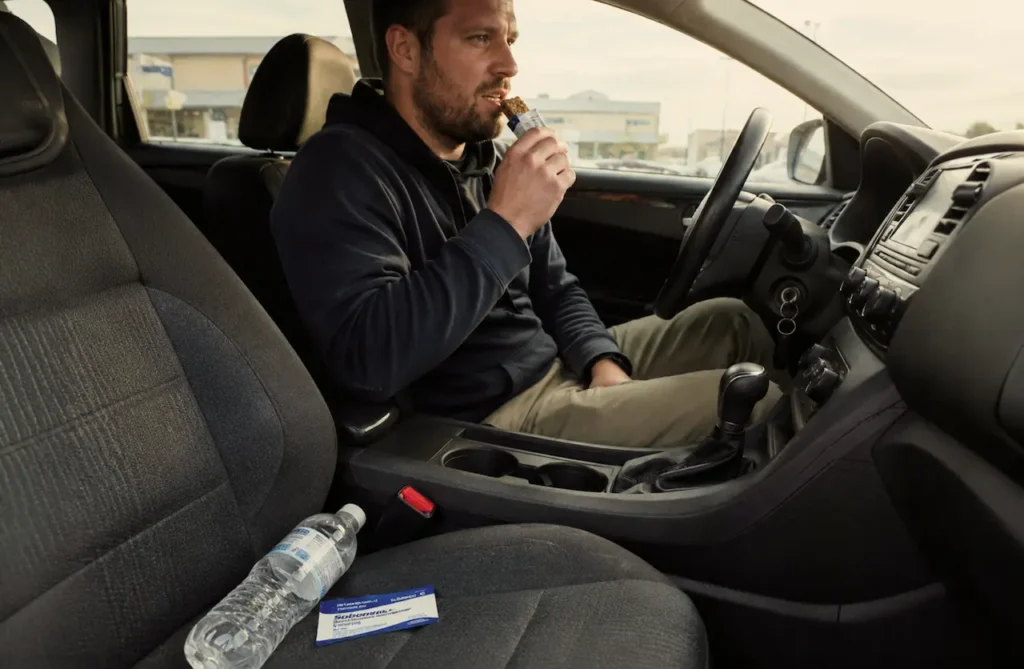
Food or drink can leave residue behind, and that residue keeps the film from making full contact with the tissue it needs to absorb into. That’s why you wait until the film is completely dissolved before eating or drinking again, usually around 15-30 minutes. Once it’s dissolved, you can spit out any remaining saliva if it helps. This is sometimes called the “spit trick.” Not everyone needs to do it, but it’s an option if you’re dealing with an aftertaste or stomach discomfort.
Should you take Suboxone on an empty stomach or after eating?
Either way can work, and neither one is wrong.
If you notice more nausea or lightheadedness on an empty stomach, a light meal beforehand can help settle things and keep your blood sugar steady. If you’d rather dose first thing, that’s fine too.
Rinse your mouth with plain water if you’ve eaten recently, and wait at least 15-30 minutes before your dose so no residue gets in the way. If nausea is your main concern, a small, plain snack 30 minutes ahead, like crackers, toast, or a piece of fruit, is a reasonable place to start. Heavier, greasier, or more acidic foods tend to add to stomach discomfort rather than ease it.
Most patients settle into a routine within the first few weeks that works for their schedule and their body. If you’ve been on Suboxone for a while and haven’t found a rhythm that feels comfortable yet, that’s worth mentioning at your next visit rather than something to keep working around on your own.
Taking Suboxone the right way
A few habits from the FDA prescribing information for buprenorphine-naloxone sublingual film can help you get consistent results from every dose:
- Place the film under your tongue and let it dissolve completely. Don’t cut, chew, swallow it, or move it.
- Don’t eat or drink anything until the film has fully dissolved.
- Once it’s dissolved, take a sip of water, swish gently, and swallow. Wait at least an hour before brushing your teeth, since brushing too soon after dosing has been linked to dental problems.
- At QuickMD, we recommend waiting at least 15-30 minutes after the film dissolves before eating, drinking, smoking, or vaping, so nothing gets in the way of absorption.
- Take it at the same time each day. A consistent routine helps keep withdrawal symptoms away.
If you’d like to learn more about how to take Suboxone the right way, check out our step-by-step guide to taking Suboxone.
Common stomach side effects and how to manage them
Nausea and constipation catch a lot of patients off guard, especially in the first weeks of treatment, but they’re expected, not a sign that something’s wrong or that your dose needs to change, and they usually improve once your body gets used to your medication.
Buprenorphine is a partial opioid, and research on opioid-induced constipation shows that it can affect your digestion in a couple of ways. It can trigger nausea while your body adjusts, and it can slow things down enough to cause constipation.
A few things may help in the meantime:
- A light, plain meal before dosing may ease nausea.
- Staying hydrated and eating fiber-rich foods may help with constipation.
- Eating smaller, more frequent meals instead of large ones can also ease digestion for some patients.
If you’re further along in treatment and these symptoms are new or have changed, talk to your QuickMD doctor. They can help you understand what’s happening or adjust your dose if needed. Our guide to managing Suboxone side effects goes into more detail if you’d like to learn more.
Getting the most out of your dose
A few small habits can make each dose more effective and more comfortable:
- Rinse your mouth with plain water before dosing if you’ve just eaten, to clear away food residue.
- Try not to talk while the film is dissolving. Swallowing saliva while it’s in place can carry part of your dose away before it’s fully absorbed and could cause an upset stomach.
- Keep dosing at the same time and in the same way each day.
If your stomach symptoms change or get worse, or if a dose stops feeling like it’s working the same way, reach out to your QuickMD doctor and have a conversation rather than adjusting it on your own.
Frequently asked questions about Suboxone and food
Can you take Suboxone on an empty stomach?
Yes. Suboxone is absorbed through the tissue under your tongue, not through your stomach, so an empty stomach doesn’t stop it from working. Some patients simply notice nausea more on an empty stomach, which is a comfort issue rather than an effectiveness one.
Does food stop Suboxone from working?
No. Food doesn’t block Suboxone from being absorbed. What matters is avoiding food or drink until the film has fully dissolved, since residue in your mouth can interfere with contact with the tissue that absorbs it.
Why does Suboxone make me nauseous?
Buprenorphine is a partial opioid, and opioid activity in your body can trigger nausea, especially early in treatment. It tends to ease as your body adjusts.
What should I eat before taking Suboxone?
A light, plain snack or meal beforehand may help settle your stomach. There’s no specific food required, just something simple, like crackers or toast, that sits well with you and doesn’t leave much residue behind.
How long should I wait to eat or drink after taking Suboxone?
We recommend waiting at least 15-30 minutes after the film fully dissolves before eating, drinking, smoking, or vaping. Waiting the full 15-30 minutes gives the medication time to fully absorb before anything else is introduced.
What if I already ate or drank something before my dose dissolved?
Residue in your mouth may slightly slow absorption for that dose, but it isn’t something to worry over or a reason to redose. Rinse with plain water, and try to wait until the film fully dissolves next time before eating or drinking.
Disclaimer
Articles on this website are meant for educational purposes only and are not intended to replace professional medical advice, diagnosis or treatment. Do not delay care because of the content on this site. If you think you are experiencing a medical emergency, please call your doctor immediately or call 911 (if within the United States). This blog and its content are the intellectual property of QuickMD LLC and may not be copied or used without permission.
References
Buprenorphine and naloxone sublingual film. (n.d.). DailyMed, U.S. National Library of Medicine, National Institutes of Health. https://dailymed.nlm.nih.gov/dailymed/drugInfo.cfm?setid=300ae3d0-464c-d0be-e063-6294a90a7f9d
Opioid-induced constipation: Rationale for the role of norbuprenorphine in buprenorphine-treated individuals. National Center for Biotechnology Information (PMC), National Library of Medicine. https://pmc.ncbi.nlm.nih.gov/articles/PMC4913538/
Orman, J. S., & Keating, G. M. (2009). Buprenorphine/naloxone. Drugs, 69(5), 577–607. https://doi.org/10.2165/00003495-200969050-00006
Buprenorphine hydrochloride. FDA Drug Label. Food and Drug Administration. Updated date: 2026-07-17.
Buprenorphine for Opioid Use Disorder—An Essential Medical Treatment. JAMA Internal Medicine. 2024. Weimer MB, Morford KL.
QuickMD has strict referencing policies and relies on reputable sources, including peer-reviewed research, clinical guidelines, medical organizations, and government and public health agencies, among others. Learn more about how we ensure accuracy in our content by reading our editorial guidelines.